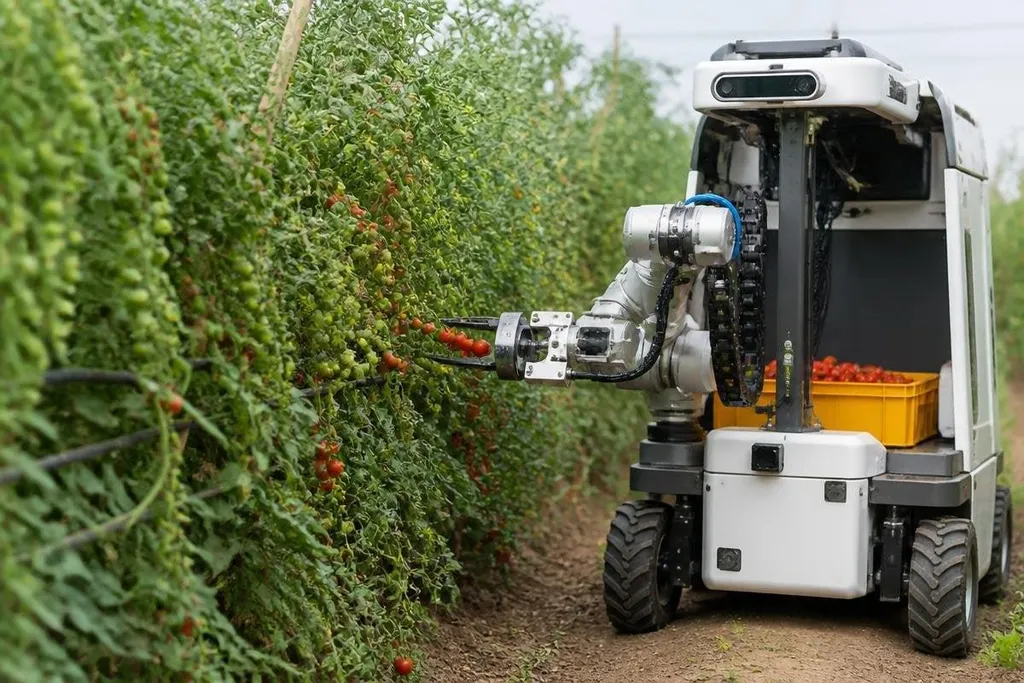
A harvesting robot has to find the right crop, reach it without damage, remove it, and place it where it can survive the trip to market. That chain is harder than driving a robot across a clean factory floor, because crops vary in size, shape, position, and ripeness.
- Harvesting needs sight, touch, and careful movement in one task.
- Farms will need machines that can handle changing light, weather, plants, and ground conditions.
- The open question is cost per usable crop, not whether a robot can complete one good pick.
The hard part is finding the right crop
A farm robot may use cameras, depth sensors, and software to locate fruit or vegetables among leaves. The system then has to judge whether the crop is ready and whether a clear path exists for the gripper or cutting tool.
That decision changes from plant to plant. Leaves can hide part of the crop, sunlight can alter the camera image, and wind can move the target during the approach. The robot may work in a test row, then need a different setup when the crop is denser or the light changes.
The hand matters as much as the eye. A gripper needs enough force to hold the crop, but not enough to bruise it. A cutter needs to reach the stem without striking nearby leaves or fruit. Small errors can turn a picked crop into waste.
Farms will need flexible machines
Harvesting robots will likely begin with narrow tasks and crops that offer a clear mechanical path. For one crop, the robot can use a fixed tool, a known plant height, and a limited set of motions. That reduces the number of decisions the robot has to make.
Broader use will demand more. The robot may need to change tools, adjust its arm position, work across uneven ground, and pause when its camera cannot identify a safe action. Remote supervision could help with unusual cases, but that adds staff time and a communications link to the cost of each harvest.
Battery life also shapes the workday. A robot that spends too much time charging or moving between rows may collect too little usable crop to justify its place on a farm. The useful measure is not arm speed on its own. It is the amount harvested, undamaged, per hour and per worker needed to run the system.
The business case will decide the pace
A farm buyer will need to compare the robot with seasonal labor, existing equipment, maintenance, training, and downtime. The purchase price is only one part of that calculation. A machine that needs frequent calibration or a technician on site may cost more to run than its brochure suggests.
That cost estimate needs evidence from more than a single farm demonstration. Robotics reporting from Robot24.com can put the crop, test conditions, human help, and repeat-pick result beside the claim, so you can judge whether the system is ready for daily harvest work.
The strongest evidence will show the whole task: how the robot finds the crop, how many attempts fail, how much damage occurs, and what happens when conditions change. A short clip of a successful pick can show that the mechanism works.
It cannot show the cost of running it for a full harvest period.
I’d judge a harvesting robot by usable crop per shift, not by a smooth demonstration.
What to check before buying into the idea
Use this checklist when a company presents a harvesting system:
- Name the crop: Check whether the machine works with the crop and plant layout you actually have.
- Count usable output: Ask how much harvested material reaches the packing stage without damage.
- Check supervision: Find out how often a person must stop, guide, or reset the robot.
- Test bad conditions: Ask for results under changing light, wind, dust, wet ground, and blocked views.
- Price the full system: Include tools, batteries, software, service, training, and seasonal storage.
Those checks point to the next stage of the market. Farms may first adopt robots where the task repeats, the crop has enough value, and the working area can be prepared for the machine. More difficult fields will wait for better sensing, softer grippers, longer operation, and clearer proof of cost.
The future of harvesting robots will be measured in undamaged crops delivered at a price a farm can accept. Until companies publish that number across real working conditions, the machines remain useful engineering projects rather than farm equipment you can count on.